The Complete Wedding Stationery Timeline: When to Order and Send Everything
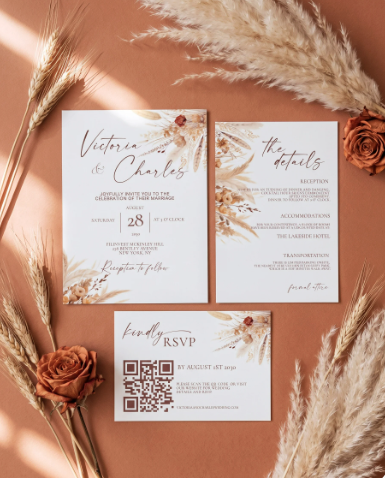
Save the dates, invitations, order of service and thank you cards all have their own deadlines. Here is when each one needs to happen, working backwards from your wedding day.
Most wedding stationery advice tells you what to send. Far less of it tells you when, which is the part couples actually get wrong.
Send save the dates too late and half your guests have already booked a holiday. Order invitations too close to the day and you are paying for express delivery on top of everything else. Set your RSVP deadline too early and people forget to reply because the wedding still feels a year away.
This is a full stationery timeline, working backwards from the wedding date, with the points where things commonly slip.
The timeline at a glance
Twelve months and earlier: save the dates for special cases
Some weddings need a longer run-up than others. Send save the dates twelve months ahead if you are marrying abroad, over a bank holiday weekend, or between Christmas and New Year.
Guests travelling internationally need time for flights, accommodation and annual leave. Bank holiday weekends fill quickly, and if half your guest list is trying to book the same weekend as everyone else in the country, an early notice genuinely helps.
One rule matters more than any timing guidance: anyone who receives a save the date must receive an invitation. Keep any reserve list off that first mailing entirely, because there is no graceful way to walk it back.
Eight to twelve months: save the dates for a UK wedding
For a wedding in the UK with mostly domestic guests, eight to nine months is comfortable. Earlier is fine. Later starts to defeat the purpose, since the point of a save the date is to reach people before they commit the weekend to something else.
A save the date is a holding notice, not a preview of the invitation. It needs your names, the date, a rough location and one line confirming the invitation is coming. Resist adding detail you have not confirmed yet. A save the date that names a venue you later change is worse than one that says only the county.
If your engagement is shorter than six months, skip save the dates entirely and go straight to invitations. Two mailings four weeks apart confuses people more than it helps.
Eight to nine months: collect your addresses
This is the stage nobody puts on a timeline, and it is the one that most often holds everything else up.
You cannot post invitations without addresses, and gathering a hundred of them takes longer than anyone expects. People have moved. Old Christmas card lists are out of date. Half your list lives in a group chat rather than an address book.
Start collecting eight to nine months out, well before you need them, and ask directly rather than reconstructing from memory. A short message to each household, or a simple online form sent round the group, produces more accurate results in a fortnight than guesswork produces in two months.
Capture more than the address while you are asking. Note how each person prefers to be addressed, whether they hold a professional title, and whether their children and partners are included. All three are far easier to ask about now than to guess at when you are sitting in front of a hundred envelopes.
Keep it all in one place, in a spreadsheet rather than across messages, because you will need the same list again for thank you cards afterwards.
Six to eight months: design and wording
This is the stage couples underestimate, because it feels like the easy part and turns out not to be.
Settle your wording before you finalise your design. Long names, two sets of hosting parents or a lengthy venue address all change how much room a layout needs, and it is far easier to build a design around finished wording than to trim wording to fit a design you have already committed to.
Work out at this stage how many invitations you actually need. One per household rather than one per guest, with a handful spare for last-minute additions and the ones that go astray in the post. Couples routinely order to guest count and end up with far more than they need.
This is also where the route you choose starts to matter for everything that follows. A designer or printer needs lead time. Working from free wedding templates or a print-at-home option removes that constraint, which gives you far more flexibility later if your guest list changes or a detail needs correcting after you thought everything was settled.
Four to six months: ordering
If you are using a stationer or a professional printer, this is your deadline. Custom design typically takes four to six weeks on its own, before printing, and anything involving letterpress, foiling or hand finishing takes longer.
Build in time for proofs. You will want to see a physical sample rather than a screen version, because colours print differently and paper weight is impossible to judge from a photograph. Assume at least one round of corrections, because there is almost always one.
If you are printing at home or using an online print service, you have more room. Even so, order your paper stock early and test it in your printer before you commit to the full run. Heavy card jams printers that handle ordinary paper perfectly well, and finding that out with three weeks to go is not the moment you want it.
How many to order
Order to households, not to headcount. A guest list of a hundred and twenty people is rarely a hundred and twenty invitations, because couples and families share one.
A list of a hundred and twenty typically needs somewhere between seventy and eighty invitations. Work through the list properly and count envelopes rather than names, because the difference between the two is significant enough to matter.
Then add spares. Ten per cent is a sensible margin, and it covers the invitation that goes astray in the post, the one you address wrongly, the late addition once a declined reply frees a seat, and the one you keep for yourselves. Reprinting a handful of invitations costs far more per piece than including them in the original run, because you are paying setup costs twice.
Two exceptions to the one-per-household rule. Anyone eighteen or over living at home receives their own invitation. And housemates sharing an address each receive their own, since they are not a household in the way a couple is.
The proofing stage
However you are producing your stationery, build in time to check it properly, because this is the last point at which a mistake costs nothing.
Ask for a physical proof rather than approving from a screen. Colours print differently from how they display, and paper weight is impossible to judge from a photograph. If you are printing at home, run a single test copy on your actual paper stock before committing to the full run.
Check it in daylight, and check it against the details rather than reading it as prose. Names, spellings, the date, the day of the week, the time, the venue, the postcode, the RSVP deadline and the website address. Reading for sense will not catch a transposed digit in a postcode, because your brain fills it in.
Then give it to someone who has had nothing to do with it. Every couple reaches a point where they have read their own invitation so many times that they can no longer see it, and a fresh reader will find in thirty seconds what you have missed for a fortnight.
Assume at least one round of corrections. There almost always is one, and a timeline that has no room for it will slip.
Three months: sending invitations
Three months before the wedding is the standard UK window. Traditionally invitations were posted five to eight weeks ahead, which still works for a small local wedding, though most couples now allow longer.
Send everything in one mailing. Day guests and evening guests should receive their invitations at the same time, not in separate waves, because evening guests notice when their invitation arrives a fortnight after everybody else's.
Weigh a completed invitation before buying stamps. Royal Mail prices by size and thickness as well as weight, so a square invitation, a heavy card or one with a wax seal can move into a higher bracket. Take one assembled invitation, envelope and inserts included, to the post office and have it measured rather than estimating.
If you are including a reply card for guests to post back, it needs its own stamp. This is the single most commonly forgotten cost in wedding stationery.
Six to eight weeks before: the RSVP deadline
Set your reply deadline six to eight weeks before the wedding, and work backwards from when your venue needs final numbers rather than picking a date that sounds about right.
The instinct is to set it early, which is usually a mistake. A deadline that sits five months out feels distant, so guests put the card on the fridge and forget it. A deadline six weeks before the wedding feels immediate, and people respond to it.
Whatever date you choose, assume you will be chasing. Somewhere between a fifth and a quarter of guests will not reply by the deadline, and that is normal rather than a sign that anything has gone wrong. Budget a week for polite follow-up before you send numbers to the venue.
Give guests one way to reply rather than two. A posted reply card and an online form running together produces duplicate responses, missing responses and a spreadsheet you will come to resent.
After the deadline: chasing replies
Between a fifth and a quarter of your guests will not reply by the date on the card. This is normal, it is not a reflection of how they feel about your wedding, and planning for it is easier than being annoyed by it.
Build a fortnight of chasing into the timeline between your RSVP deadline and the date your venue needs final numbers. Without that gap, the chasing eats into the week you need for the table plan.
A workable sequence: a light group message a few days after the deadline, a direct individual message a week later, and a phone call to anyone still outstanding after that. Most people reply to the first nudge and are slightly embarrassed to have needed it.
Delegate where you can. A parent or a member of the wedding party chasing their own side of the list is faster than one of you working through everybody, and it removes the awkwardness of asking your own relatives twice.
Set a personal cut-off after which a non-reply counts as a no, and tell people that date when you chase. It is not unkind, and it is considerably better than guessing at numbers you are paying for.
Four to six weeks before: on the day stationery
Order of service, table plan, place cards, menus and signage can all wait until numbers firm up. Ordering earlier means reprinting when the guest list shifts, which it will.
Order of service is the exception if you are having a church wedding, since it needs the hymns, readings and readers confirmed with your vicar, and that conversation is worth having earlier than you think.
Note the naming convention. A religious ceremony has an order of service. A civil ceremony has an order of the day or an order of ceremony. It is a small thing and stationers notice it.
The final fortnight
Two to three weeks out, final numbers go to the venue and the table plan can be built. Leave place cards and any name-specific printing until the last possible moment, because there is always a late change.
A week before, print or collect everything that goes on tables and walls. Check every name spelling against something more reliable than memory, and have someone who has not been involved read the table plan and the order of service. Fresh eyes catch what you have stopped being able to see.
One thing worth checking twice: that the day of the week matches the calendar date on every printed piece. Proofreaders catch spelling. They rarely catch a Saturday that is actually a Sunday.
After the wedding: thank you cards
Send thank you cards within three months of the wedding. Sooner if you can manage it, though nobody is counting the weeks in the way older etiquette guides suggest.
Order them at the same time as your invitations if you want them to match. It is one less thing to organise when you get back, and printers give better prices on a combined order.
Each card should name the gift and say something specific about it. For money, thank the giver for their generosity without naming the amount and say what it is going towards. The card itself can be printed. The message inside should be handwritten.
What changes the timeline
Destination weddings
Add three to six months to everything. Save the dates twelve months ahead, invitations four to six months ahead, and an RSVP deadline early enough that guests have booked flights before you commit to numbers.
Short engagements
Under six months, skip save the dates and send invitations as soon as the venue is confirmed. Six to eight weeks' notice is enough if guests are local, and templates or a quick-turnaround printer are worth more than a stationer's lead time.
Bank holidays and Christmas
Add two to three months to your save the date timing. These weekends book up early, and travel is more complicated than usual.
The legal timeline runs alongside
Your stationery timeline is not your only deadline. Notice must be given at a register office at least twenty-eight full days before a civil ceremony, and banns for a Church of England wedding are read on three Sundays in the three months before the day. Citizens Advice sets out the full legal requirements, including the seven-day residency rule and the twelve-month window in which the ceremony must take place. Neither affects your stationery directly, but both need to be in the diary alongside it.
A worked example
Take a wedding on Saturday 19 June 2027, a summer Saturday in the UK with a mostly domestic guest list. Working backwards, the stationery timeline looks like this.
- September 2026, nine months out: start collecting addresses and send save the dates.
- October to December 2026: settle the wording, choose the design, work out how many invitations you need.
- January to February 2027: order invitations if using a designer or printer, allowing time for proofs.
- Mid-March 2027, three months out: post the invitations, day and evening guests together.
- End of April 2027: RSVP deadline, roughly seven weeks before the wedding.
- Early May 2027: chase outstanding replies, allowing a fortnight.
- Mid-May 2027: final numbers to the venue, order on the day stationery.
- Early June 2027: table plan finalised, place cards and signage printed.
- By September 2027: thank you cards sent.
Write your own version of that on a single page. Once the sequence exists on paper it stops being a source of low-level anxiety and becomes a list, which is a considerably better way to carry it for a year.
If you are already behind
Plenty of couples find this article three months before the wedding with nothing ordered, and it is far more recoverable than it feels.
Skip save the dates entirely. Their purpose is to reserve a date months in advance, and at this stage the invitation does that job by itself.
Choose a route with no production lead time. Printing at home or using a quick-turnaround online service removes four to six weeks from the schedule immediately, and that is usually the single biggest saving available.
Simplify the suite. An invitation and a reply card will do everything a five-piece suite does. Details that would have gone on an enclosure card can live on your wedding website, and signage can be produced in the final fortnight.
Set the RSVP deadline as tight as your venue allows, and say plainly on the card that you are working to a short timeline. Guests are considerably more understanding about this than couples expect, and most reply faster when they know the deadline is real.
Six weeks is genuinely enough notice for a local wedding. It is not what anybody plans for, but it works.
The timing mistakes worth avoiding
Sending save the dates to people you are not certain about inviting. Anyone who receives one must receive an invitation.
Setting the RSVP deadline months in advance. Distant deadlines get ignored.
Ordering on the day stationery before numbers are final. You will be reprinting.
Buying stamps before weighing and measuring a completed invitation.
Forgetting the stamp on the reply card.
Ordering to guest count rather than household count. One invitation per address, plus a few spare.
Leaving order of service until the final weeks when hymns and readings still need confirming with your vicar.
Leaving no gap between the RSVP deadline and the date your venue needs final numbers.
Approving a proof from a screen rather than checking a physical copy in daylight.
Working backwards
The simplest way to build your own version of this timeline is to write your wedding date at the bottom of a page and work upwards. Final numbers, RSVP deadline, invitations posted, invitations ordered, wording settled, save the dates sent.
Each deadline sets the one above it. Once the sequence is written down it stops being a source of low-level anxiety and becomes a list, which is a considerably better way to carry it around for the next year.
